
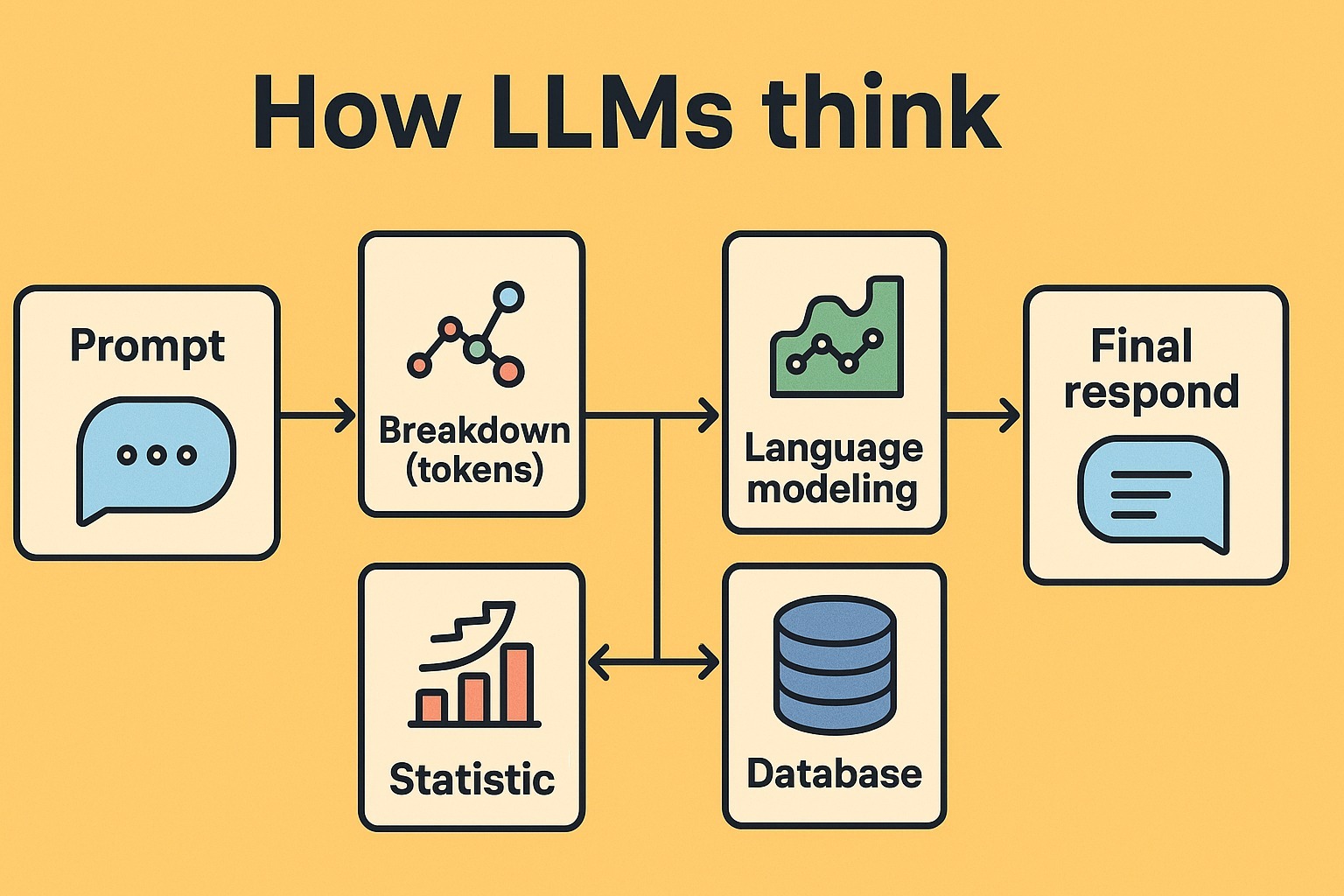
How models like ChatGPT actually generate their answers
Have you ever wondered how a model like ChatGPT comes up with its responses?
Let’s break it down simply — in plain language — based on what I’ve learned from a few reliable sources (linked below).
🤖 What LLMs Actually Are
LLMs (Large Language Models) don’t think like humans.
They don’t browse the internet in real time, and they don’t pull ready-made answers from a live database.
When you see “web browsing” in some GPT versions, that’s just an external tool, not a built-in ability of the model itself.
Instead, the model creates answers based on patterns it learned during training —
from massive amounts of data.
And by “massive,” I mean on a scale that’s almost cosmic — terabytes upon terabytes of text data.
⚙️ The Simplified Logic
Here’s how it works, step by step:
1️⃣ You ask a question — this is called a prompt.
2️⃣ The system breaks it down into small units called tokens (pieces of words).
3️⃣ Based on statistical probability, it predicts the most likely next token… then the next… and so on — word by word — until it forms a complete response.
🧩 What Happens Behind the Scenes
While generating that text, the model relies on:
- Its training data and historical context
- Language patterns and sentence structures
- The context of your specific prompt
- Human feedback (RLHF – Reinforcement Learning from Human Feedback)
A) If your question resembles something it has already “seen,” it gives a sharper, more accurate answer.
B) If it’s something totally new, it tries to compose an answer from related patterns — which is why responses aren’t always 100% correct or factual.
⚠️ Important: LLMs Don’t “Understand”
They have no awareness, emotion, or real comprehension.
They are advanced prediction and synthesis machines.
When you type a question, they simply predict the most likely next word based on their training data.
That’s it.
And that’s why prompt design (prompt engineering) is such a critical skill —
because how you phrase your question directly shapes how the model predicts and constructs its answer.
🧠 In Short
LLMs don’t “know” things — they generate them.
Every time ChatGPT gives you an answer, it’s building it on the fly — connecting fragments of patterns like puzzle pieces.
Over time, as models are retrained on better data and human feedback, they become more refined, more context-aware, and more useful for real-world tasks.